Magu CBD
    CBD vs HHC vs H4CBD: Differences & Legal Status in Austria
    July 30, 2026

    CBD vs HHC vs H4CBD: Differences & Legal Status in Austria

    Note: this article is a neutral knowledge and comparison article on cannabinoids – HHC vs CBD vs H4CBD. MAGU sells exclusively CBD products and accessories. We offer neither HHC nor H4CBD and do not give any recommendations for consumption or healing.

    CBD, HHC and H4CBD – three very different cannabinoids

    In recent years, many new hemp-related cannabinoids have come onto the market. Besides the well-researched cannabidiol (CBD), HHC (hexahydrocannabinol) and H4CBD (hydro-CBD, “hydrogenated CBD”) in particular come up frequently. This article classifies the three substances objectively: chemically, in terms of effect and within the legal framework in Austria and Germany.

    What is CBD?

    Cannabidiol (CBD) is a cannabinoid that occurs naturally in the hemp plant. It is not intoxicating, i.e. it does not produce a “high” like THC. CBD is by far the best-researched non-psychoactive cannabinoid and is used in cosmetics, oral cosmetics, smoking products and medical research, among other things.

    • Origin: natural, extracted from the hemp plant
    • Psychoactivity: not intoxicating
    • Legal framework AT: approved as cosmetics, oral cosmetics, smoking products or – in a medical context – as a medicine

    What is HHC?

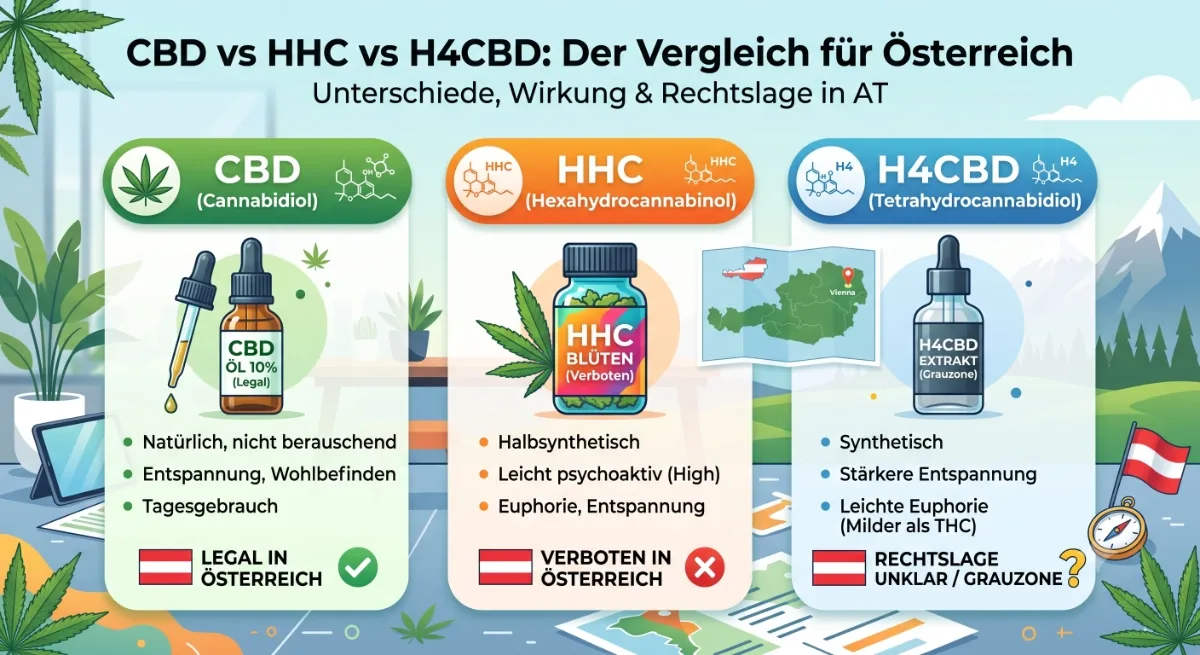
    HHC (hexahydrocannabinol) is a semi-synthetic cannabinoid. It is typically produced by hydrogenating THC or CBD in the laboratory (the molecule is “saturated” with hydrogen). HHC has a THC-like, intoxicating effect and was often sold in vapes, flower sprays or edibles.

    • Origin: semi-synthetic, produced in the laboratory
    • Psychoactivity: intoxicating (similar to, usually weaker than THC)
    • Legal status: Prohibited in Austria and Germany.

    What is H4CBD?

    H4CBD (also hydro-CBD) is likewise a semi-synthetic molecule: chemically, it is hydrogenated CBD. Although it is often advertised as “stronger CBD”, the following applies: H4CBD has little to no scientifically confirmed effect and is still largely unresearched today.

    • Origin: semi-synthetic, produced from CBD in the laboratory
    • Psychoactivity: unclear / hardly researched
    • Body of research: extremely thin – hardly any reliable data on effects, long-term consequences or safety

    CBD vs HHC vs H4CBD – the most important differences

    CBD

    • Origin: natural, from hemp
    • Intoxicating effect: no
    • Body of research: extensive
    • Typical products: oils, oral cosmetics, cosmetics, smoking products
    • Legal framework AT/DE: clearly regulated / legal

    HHC

    • Origin: semi-synthetic
    • Intoxicating effect: yes
    • Body of research: very thin
    • Typical products: formerly vapes, flower sprays, edibles
    • Legal framework AT/DE: prohibited

    In the MAGU shop: CBD Oil

    H4CBD

    • Origin: semi-synthetic (from CBD)
    • Intoxicating effect: unclear / little to no confirmed effect
    • Body of research: largely unresearched
    • Typical products: oils, vapes, edibles
    • Legal framework AT/DE: legally unclear / restrictive

    HHC: HHC is simply prohibited both in Austria (under the Neue-Psychoaktive-Substanzen-Gesetz, NPSG) and in Germany (under the Neue-psychoaktive-Stoffe-Gesetz, NpSG). Trade, import, sale and distribution are prohibited in both countries.

    H4CBD: For H4CBD, the legal situation ranges from vague to restrictive. As the substance has hardly been researched and psychoactive effects cannot be ruled out, it quickly falls under the regulations for new psychoactive substances.

    CBD: CBD is completely permitted in Austria and Germany provided the statutory THC limits are observed – for example as cosmetics, oral cosmetics and, in Austria, also in the form of smoking products.

    Legal status: early 2026. This article is no substitute for legal advice – please always check the current official sources (BASG, BMSGPK, BfArM).

    Effects and safety – what do we really know?

    CBD

    CBD has been the subject of hundreds of studies. Side effects such as tiredness or interactions with certain medicines are known. For cosmetic applications and oral cosmetics, the risk profile is low when used as intended.

    HHC

    There are hardly any reliable clinical human data on HHC; however, among the semi-synthetic cannabinoids, HHC is comparatively considered the least risky: as hydrogenated THC, the molecule behaves pharmacologically similarly to THC – in experience, around 20% weaker in effect. Because THC itself is well researched, the effect profile can be roughly classified. Nevertheless, contamination from the synthesis, unclear purities, missing long-term data and the strict ban remain key issues.

    HHC derivatives: HHCP, HHCPO, HHC-O & co. – considerably more dangerous

    The situation is different with the HHC derivatives. These molecules are chemically modified further (extended side chains, acetylation, etc.) and often act as full agonists at the CB1 receptor – with a potency many times greater than that of THC:

    • HHCP (hexahydrocannabiphorol): HHC analogue with an extended alkyl side chain. Preclinical data suggest a CB1 binding many times stronger than THC. Even very low doses can trigger massive psychoactive effects.
    • HHC-O (HHC acetate): acetylated HHC variant, by analogy with THC-O considerably more potent than HHC. When heated (e.g. in vapes), there are additional concerns about the possible formation of harmful breakdown products (keyword: ketene).
    • HHCPO: combination of both modifications (extended chain + acetylation) – the result is a highly potent full agonist with a very narrow dose-response range and practically no clinical data.
    • Others: THCP, THC-O, HHC-H, HHC-B etc. – some synthetic, some semi-synthetic, all with similar risks.

    Why is this so problematic? Unlike THC or HHC (partial agonists), full agonists at the CB1 receptor can trigger the maximum receptor response. In practice this means: a higher risk of cannabis intoxication, panic reactions, circulatory problems, psychotic episodes and – with acetylated variants – potential lung damage when vaporised. There is no established dosage, no long-term data and no standardised purities.

    In short: compared with its derivatives, HHC is the “most harmless” molecule of this family – but that does not change the ban or the open safety questions. HHCP, HHC-O, HHCPO and similar substances are a different category pharmacologically and, in our view, are clearly to be rejected.

    H4CBD

    There are insufficient human studies on H4CBD. There are little to no scientifically confirmed effects, and the molecule as a whole is largely unresearched. Due to the lack of data, it is not possible to say reliably what short- or long-term effects the substance actually has.

    Why MAGU relies exclusively on CBD

    We have deliberately decided against HHC, H4CBD and other semi-synthetic cannabinoids. The reasons:

    • Transparency & quality: We rely on tested quality and a transparent supply chain – semi-synthetic, unresearched substances do not fit our standards.
    • Safety: For CBD there are reliable data and clear analysis standards. With HHC/H4CBD, purities, effects and by-products are completely unclear.
    • Legal certainty: CBD is clearly regulated and legal in Austria and Germany. HHC is prohibited; H4CBD is highly risky legally and in terms of health.
    • Attitude: We see our responsibility in offering reputable, tested products – not unresearched grey-area cannabinoids.

    Frequently asked questions (FAQ)

    Viennese premium quality for your well-being – free shipping to AT & DE from €49!