
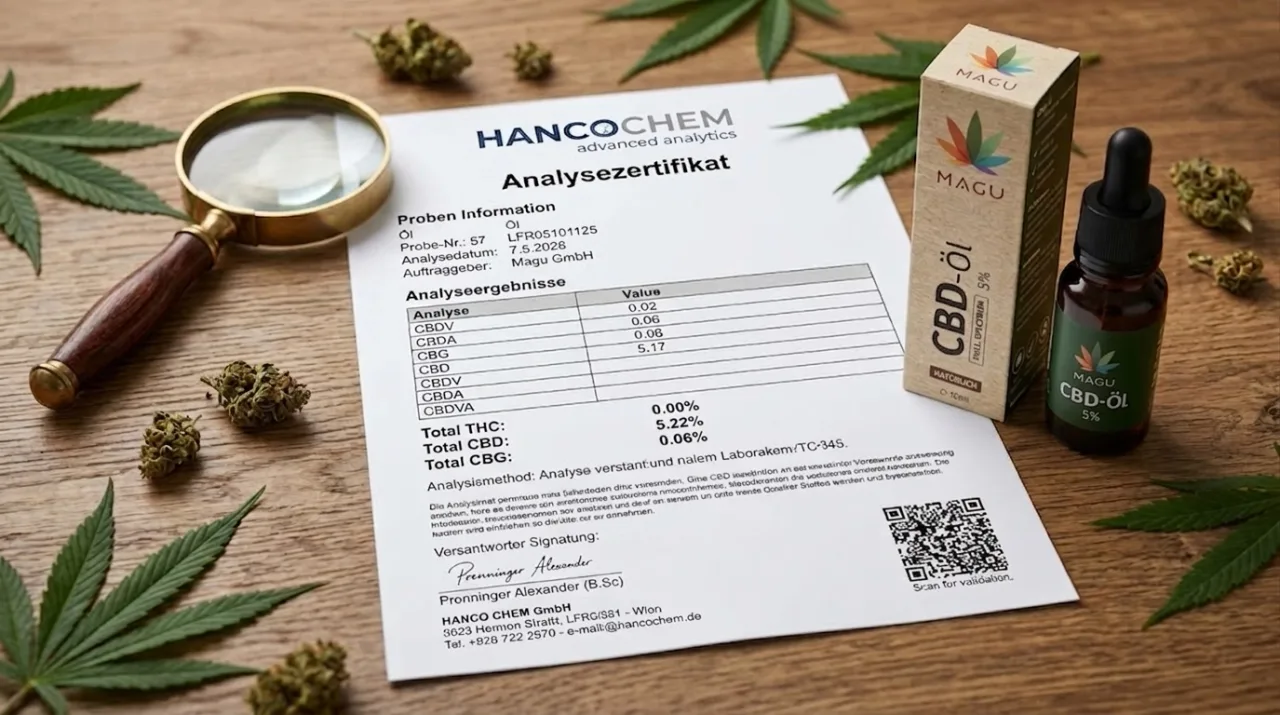
A certificate of analysis – CoA in technical jargon, short for Certificate of Analysis – is the most honest document a CBD product can come with. This CBD lab report shows what is actually inside. But it is of little use if you cannot put the figures into context. Here we go through a CoA from top to bottom.
1. Header: who tested what, and when?
At the very top are the laboratory, the client, the test date and the sample name. Three things are crucial:
- Independent laboratory instead of in-house analysis
- Test date: A certificate from 2019 says nothing about today’s batch; however, as the hemp plants are always harvested in autumn, it is normal for certificates to be up to 1.5 years old.
- Batch or lot number, which you will find again on your bottle. Without this link, the document is arbitrary.
2. Cannabinoid profile
The central table lists the individual cannabinoids, usually in per cent and in mg per gram or millilitre. Here is what you should look out for:
- CBD and CBDA: In uncut raw extract, much of the cannabidiol is present in its acid form, CBDA. Reputable certificates therefore state a “Total CBD” value that takes the conversion into account.
- Consistency with the label: Do a quick calculation. A 10 ml bottle at 10% should contain around 1,000 mg of CBD. Deviations of a few per cent are normal, large gaps are not.
- Minor cannabinoids such as CBG, CBC or CBN show whether it is a full spectrum product.
- LOQ/LOD: “< LOQ” means that the substance is below the limit of quantification – not necessarily “zero”.